

Restricted vs Unrestricted Funds in Local Government: Governance, Risks and Controls
For many NSW councils, financial sustainability is a real risk and not just something in a risk register. Managing financial expenditure i.e. public funds in accordance with legislation is critical. But the real financial question is not how much cash sits on the balance sheet, it is how much of that cash is actually available to use. That is why understanding restricted vs unrestricted funds in local government is critical.
In NSW local government, the restricted vs unrestricted funds distinction matters because a significant share of council cash is either legally quarantined, internally allocated for future purposes, or needed to maintain liquidity for day-to-day operations. The recent NSW Audit Office’s Local government 2025 report identified that:
- 19 councils did not have enough cash and investments not subject to external restrictions to cover three months of general expenses, and
- weaknesses in internal controls and governance were identified at most councils.
For this, and many other important reasons, restricted and unrestricted funds should be treated as a frontline governance issue, not just a finance note at year end.
The legislative and policy framework is clear. The Local Government Act 1993 (the Act) says money raised by a special rate or charge, money that legislation says can only be used for a specific purpose, and specific purpose advances or grants from government cannot be used for other purposes except in limited circumstances.
The Office of Local Government (OLG) Local Government Code of Accounting Practice and Financial Reporting (OLG Code) also requires councils to maintain adequate accounting records, systems and internal controls, and to disclose restricted and allocated cash, cash equivalents and investments in their financial statements.
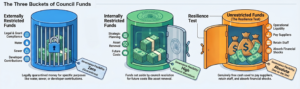
Council funds sit in 3 ‘buckets’
In simple terms, council funds typically sit in three distinct ‘buckets’:
- Externally restricted funds: money that council is legally required to use for a specific purpose it was provided.
- Internally restricted funds: money that council has set aside by resolution for a specific future purpose, These funds are not ‘legally’ restricted, but they should only be moved or repurposed through formal council resolution.
- Unrestricted funds: money that is available to support day-to-day operations, manage cash flow, respond to unexpected costs and maintain financial flexibility.
Why externally restricted funds matter
Externally restricted funds are the most tightly controlled category of council cash. These are amounts that council holds because legislation or a third-party agreement says the money can only be used for a defined purpose. The OLG Code describes them as cash, cash equivalents and investments available only for specific use because of legislation or third-party contractual agreement, and requires councils to disclose both the amount and nature of those restrictions. Common examples include water funds, sewer funds, developer contributions, domestic waste management, stormwater management and tied grants.
The purpose of external restriction is simple – it protects public trust and legal compliance. Developer contributions are collected to fund future infrastructure. Tied grants are provided to deliver a specified program. Special rates and charges are levied for a stated purpose. These are not general operating funds.
The NSW Audit Office warned that low available cash (money available as unrestricted funds) increases the risk of externally restricted cash being used for an improper purpose, and reported two high-risk findings where councils breached the Act by spending externally restricted cash and investments for an improper purpose.
The strategic role of internal restricted funds
Internal restricted funds, often described as internal allocations or reserves, are different. They are not imposed by legislation or grant conditions. They are set aside by council resolution or policy for a defined future purpose.
The OLG Code says internal allocations are cash, cash equivalents and investments allocated by council resolution or policy to identified programs of work and forward plans, and because they remain at council’s discretion they are disclosed but not deducted from total cash and investments in the same way as external restrictions.
This is where good financial leadership and governance becomes visible. Internal allocations are how councils plan ahead to smooth future costs instead of lurching from one budget shock to the next. Internal restricted funds can be used for plant and vehicle replacement, employee leave entitlements, asset replacement, IT renewal, carryover works, quarry remediation and bonds and deposits. That is exactly what a mature, proactive reserve framework should do – convert foreseeable liabilities, renewal needs and cyclical expenditures into transparent funding strategies.
The IP&R framework also reinforces this discipline. NSW councils must prepare and adopt a Long-Term Financial Plan, use it to inform decision-making, and review and update its assumptions, projected income, expenditure, balance sheet and cash flow at least annually as part of the Operational Plan.
A Council’s Annual Report is also framed as a key point of accountability to the community and must include the council’s audited financial statements. In other words, internal allocations should never sit outside strategy; they should be linked directly to the Long-Term Financial Plan, Delivery Program and Operational Plan.
Why unrestricted funds are the real test of resilience
Unrestricted funds are the balances genuinely available to support day-to-day operations and liquidity, absorb shocks and fund priorities that are not already allocated elsewhere. Unrestricted funds are the cash councils rely on to pay suppliers, continue services, retain staff, manage timing differences in capital delivery and maintain financial flexibility.
The Audit Office’s 2025 report makes it clear why this is important. 19 councils lacked enough available cash to meet three months of general expenses, and the unrestricted current ratio remains an important indicator of short-term financial capacity. The report notes the previous OLG benchmark of 1.5, meaning $1.50 in unrestricted current assets for every $1 in current liabilities.
Therefore, unrestricted cash as funding available for unexpected or emergency expenses, liquidity support, short-term cash flow, operational efficiency and long-term financial sustainability. It also sets a target level of unrestricted cash at the greater of $2 million or 50% of current liabilities not otherwise funded by restrictions or allocations, and treats an unrestricted current ratio below 1.5:1 as a trigger for immediate attention.
Governance arrangements for restricted vs unrestricted funds
The strongest councils do not manage restricted and unrestricted funds just via council resolutions, spreadsheets and memory. They manage them through formal governance arrangements.
That starts with a council-adopted policy that defines external restrictions, internal allocations and unrestricted cash. The policy should set approval pathways and links reserves to the Community Strategic Plan, Delivery Program, Operational Plan and Long-Term Financial Plan. Good practice requires any future internal allocation to be established by council resolution, with a defined purpose and a basis for calculating transfers.
From there, the control framework needs to be operational, not symbolic.
The NSW Audit Office’s better-practice observations are especially useful here. It found some councils still rely on highly manual annual processes to manage and report restricted cash, which increases the risk of error and breach. By contrast, one better-practice council case study linked its quarterly cash and investment budget review statement directly to the general ledger, configured the ledger to reflect externally restricted balances, and had the statement independently reviewed within the finance team.
The NSW Audit Office also highlighted the importance of regular reconciliation, enhanced processes and controls, transparent reporting to decision-makers, and ARIC oversight.
In practical terms, councils should have a clear ownership model. Finance owns the register and reconciliations, business units own the business purpose of each reserve, executives own challenge and reprioritisation, council owns creation and release of internal allocations by resolution, and ARIC owns oversight of control effectiveness, compliance risk and remediation actions.
Rules for moving money in, out or between funds
This is where councils most often get into trouble.
Externally restricted funds cannot simply be used to solve a general fund cash pressure. Section 409 of the Act limits the use of special rates or charges, legislatively restricted money and specific purpose advances or grants to their intended purpose. Section 410 creates only a narrow pathway for alternative use of some money raised by special rates or charges once the original purpose has been achieved or is no longer required, and only after public notice through the operational plan process.
Internal allocations are more flexible, but that does not mean they should be moved casually. Council’s should adopt a policy that is sensible i.e. transfers into or out of restricted cash require council resolution, whether through a specific resolution, adoption of the Quarterly Budget Review Statement, or adoption of annual financial statements containing a schedule of movements. The policy can state that councils may borrow from internally allocated cash, but not from externally restricted cash without Ministerial consent, and any such borrowing must be authorised by resolution with the full impact disclosed and interest paid.
That is the right principle for all councils to adopt. Legal restrictions are not optional, and internal restrictions are not informal. Even where council has discretion, reserve movements should be rule-based, transparent and documented.
The biggest risks councils need to control
The governance risk is not just technical non-compliance. It is a financial control drift. When councils lose sight of what cash is restricted, allocated or genuinely free, three risks will emerge quickly.
- Councils may misstate liquidity. A healthy cash balance can hide a weak unrestricted cash position if too much of the total balance is externally restricted. The NSW Audit Office’s analysis shows that many regional and rural councils carry high proportions of externally restricted balances, especially where water and sewer charges form a large part of cash holdings.
- Councils may create “shadow budgets” through unmanaged internal reserves. If internal allocations are not tied to a documented purpose, target funding basis, forecast drawdown and annual review, they can become stale, duplicated or politically immovable. The IP&R framework is designed to prevent that by requiring annual review of the Long-Term Financial Plan and alignment between planning, delivery and reporting.
- Councils may breach the Act through weak controls, errors or deliberate misconduct. The NSW Audit Office’s findings on externally restricted cash show that poor monitoring, manual processes and weak reporting are enough to create serious compliance failures.
The KPIs and reports that matter most
Councils should separate compliance reporting from decision-based reporting. At a minimum, councillors, executives and ARIC should receive a reporting pack that clearly distinguishes externally restricted balances, internal allocations and unrestricted cash.
The core KPIs should include the unrestricted current ratio, unrestricted cash as a percentage of current liabilities, months of general expenses covered by available cash, total externally restricted balances by category, internal allocations against target and forecast drawdown, local infrastructure contribution balances and spend rates, and the number and value of approved transfers, internal borrowings, breaches or near misses.
The NSW Audit Office’s financial sustainability analysis specifically used available cash, unrestricted current ratio and own source revenue to assess councils with heightened risk, which makes those measures especially useful for internal monitoring.
The reporting cycle should also be disciplined. The OLG Code states that councils must meet multiple financial reporting requirements, including annual audited financial reports, an annual operational plan, a Long-Term Financial Plan and quarterly budget review statements. The IP&R Guidelines require budget review statements to be reported to council within two months after the end of each quarter, except the fourth quarter, and the Annual Report to be prepared within five months of year end. Many councils have a monthly Investments Report for unrestricted cash oversight.
Restricted vs unrestricted funds – Takeaways
The strongest councils understand that reserve management is not about hoarding cash. It is about governing purpose.
Externally restricted funds protect legal and community obligations. Internal restricted funds protect future service capacity and planned asset renewal. Unrestricted funds protect resilience, liquidity and strategic choice.
When councils clearly define each category, set strict movement rules, link reserves to long-term planning, and report them transparently to council, ARIC and the community, they do more than stay compliant. They become more credible, more sustainable and strengthen the financial management and control culture.
Can we help?
Since 2001, we have worked with more than 115 NSW councils to strengthen risk management, resilience and internal controls through our internal audit and assurance services. Whichever service you choose, our goal remains the same, to help you manage risk with confidence and provide practical advice that supports informed, effective decision-making.
Can we help? If your council is reviewing its approach to restricted and unrestricted funds, reserve governance or financial control settings, contact us to discuss how we can support your needs.
#RiskManagement #InternalAudit #Assurance #Governance #LocalGovernment #FinancialSustainability #InternalControls #RestrictedFunds #UnrestrictedFunds #CouncilGovernance