
🎉 Celebrating 25 YEARS of helping organisations confidently take risk 🎉

Post-Quantum Cryptography: A Guide for CISOs

post-quantum computing

Every day we send emails, connect to cloud services, approve payments and install software updates. Cryptography helps keep information private, confirm identities and detect unauthorised changes. A future quantum computer could defeat some of the methods that underpin those protections, which makes planning for post-quantum cryptography (PQC) a priority today.

When you open a banking site or connect to a cloud application, the service needs to prove its identity and protect the data you send. Transport Layer Security (TLS), including TLS 1.3, helps do both. Many connections depend on traditional public-key methods to establish encryption keys and verify identities. If those methods fail, attackers could read captured information or impersonate a trusted service.

Quantum readiness means identifying where organisations depend on vulnerable protections and preparing to replace them while keeping services running. PQC uses mathematical methods designed to resist attacks from both conventional and quantum computers.

We recently released our whitepaper, The Quantum Shift, that sets out the business case for quantum readiness. This article focuses on what IT leaders and chief information security officers (CISOs) can do now to assess exposure, check supplier readiness and plan the transition.

The Post-Quantum Cryptography Threat: Harvest Now, Decrypt Later

An attacker can collect encrypted communications now in the hope of reading them later. A sufficiently capable quantum computer could make that possible if the communications relied on vulnerable cryptography and the attacker captured enough information. The Australian Signals Directorate (ASD) cites this risk, known as ‘harvest now, decrypt later’, as a reason to act now.

Health records, legal files, intellectual property and information about government or critical infrastructure can remain sensitive for decades. A later upgrade can protect new exchanges. An attacker who already holds a copy can still target the original protection. Assess how long each type of information needs to stay confidential and how it is protected today.

The arrival date of a cryptographically relevant quantum computer (CRQC), one capable of defeating widely used public-key methods, remains uncertain. Planning and deployment may take years. The more time you need to migrate and the longer data must stay confidential, the earlier you need to act.

The main concern is traditional public-key cryptography, including RSA, Diffie–Hellman (DH), elliptic-curve Diffie–Hellman (ECDH) and the elliptic-curve digital signature algorithm (ECDSA). These methods help systems establish keys and verify identities or digital signatures. ASD continues to support AES-256 for encrypting data. Assess how a service establishes and protects its keys as well as how it encrypts the data itself.

Why the Transition Post-Quantum Cryptography Is So Hard

A PQC transition takes years in a complex IT environment. Changes can affect how systems connect to each other, how much traffic they can handle and how they verify software updates. Test security, compatibility and performance before rollout, and plan changes around the services that need to stay available.

Older applications, embedded equipment and outsourced services can take longer to change. Some suppliers will need to release compatible software before customers can migrate. Some devices may need replacing. Build those dependencies into the delivery plan, alongside procurement lead times, funding and the need to keep older systems working during the transition.

The good news is the path is now clearer today than ever. The National Institute of Standards and Technology (NIST) published its first three PQC standards in 2024. Organisations can generally adopt the new methods through changes to technology they already use. Ask suppliers which versions support the required methods and whether an upgrade or replacement is needed.

Where You Should Be: ASD’s Timeline

ASD’s planning guidance sets three milestones for moving away from traditional public-key cryptography. Its Information Security Manual (ISM) contains controls for transition planning and for post-quantum support in new development and procurement. Check which requirements apply through your organisation’s policies, contracts or legal obligations:

  • By the end of 2026, refine the transition plan to reflect security goals, risk tolerance, dependencies and the value of your data.
  • By the end of 2028, have migration underway, starting with critical systems and data. Prioritise highly sensitive data, information that must stay confidential for years and systems that will take longer to update.
  • By the end of 2030, complete the PQC transition.
  • After 2030, continue to monitor, validate and maintain PQC implementations as threats and technology evolve.

Set internal dates that allow for supplier releases, procurement and testing. In the refined plan, name an accountable owner, identify which services will move first and define what evidence leadership will use to confirm that the changes work.

A Practical Approach Aligned to ASD’s LATICE Framework

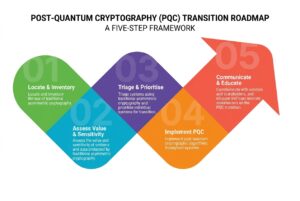
ASD’s LATICE framework sets out five phases. Locate and inventory vulnerable cryptography, assess the affected systems and data, and triage systems for migration. Implement post-quantum methods and communicate with vendors and stakeholders throughout, including education and training. InConsult recommends using this work to produce three outputs that fit the scale and complexity of your organisation. An exposure assessment shows where to start, a supplier readiness register shows what delivery depends on, and a resourced transition roadmap sets out who will deliver the changes and how they will be tested.

Post-Quantum Cryptography

Post-Quantum Cryptography Readiness Checklist

How ready is your organisation? Use these ten questions to test what you can show today.:

  1. Do we know which cloud services, applications, hardware and operational systems depend on traditional public-key methods such as RSA, DH, ECDH or ECDSA?
  2. Have we started an inventory, such as a cryptographic bill of materials (CBOM), that records what the cryptography protects and what it depends on?
  3. Have we identified which information must remain confidential through the transition and beyond?
  4. Have we ranked systems by their business impact, data sensitivity and difficulty of change?
  5. Do we have a refined transition plan and a roadmap that assigns resources and reflects ASD’s milestones?
  6. Have we named an accountable executive and owners for the changes to critical services?
  7. Does our supplier readiness register record the products and versions in use, transition dates and evidence of supplier commitments?
  8. Do we check for PQC support and cryptographic agility, the ability to change protections without disrupting services, in procurement and renewals?
  9. Is quantum exposure in our risk register, and do executives or the board receive updates on material gaps and delivery risks?
  10. Have we planned a pilot to test security, performance and compatibility before rollout?

Every “no” is a place to start. If most of your answers are “no”, begin with questions 1 to 3, because everything else depends on them.

Frequently Asked Questions

Can quantum computers break today’s encryption?

Breaking widely used public-key algorithms at practical key sizes would require a more capable quantum computer than any demonstrated publicly. The arrival date is uncertain. Captured communications could become readable later if they relied on vulnerable methods and an attacker retained enough material to decrypt them.

Which cryptographic protections need to change?

Start with the vulnerable public-key methods that establish keys and verify identities or signatures. A service may already encrypt data with AES-256 and still depend on a vulnerable way to establish its keys. The inventory should show how those protections work together so you know what needs replacing.

How does post-quantum cryptography differ from quantum key distribution?

PQC uses algorithms designed to resist both conventional and quantum attacks. It runs on ordinary computers, although older products may still need upgrades or replacement. Quantum key distribution (QKD) uses quantum physics and specialised equipment to distribute keys. ASD points to practical constraints with QKD, including hardware and availability, and recommends PQC for the transition.

Where should we start?

Start with a cryptographic inventory for the services and suppliers that handle your most sensitive information. Use it to assess the business impact of a loss of confidentiality or trust. In parallel, ask vendors for evidence about the products in use and when supported changes will be available.

Final Thoughts

The more sensitive the information, the earlier its protection needs attention. A captured copy can outlast the system that sent it and your organisation’s relationship with the people it describes.

Test how you would respond if older data became readable. A shared supplier may be helping several affected organisations at once, so consider who would support customers while your team investigates. Earlier migration shortens the period in which attackers can collect new communications that rely on vulnerable protection.

Make Your Next Move with InConsult

InConsult’s cyber risk team helps organisations turn technical findings into business priorities. We work with IT teams, suppliers and leadership to agree on owners and funding, and to define what evidence will show the changes work.

  • Build an exposure assessment. Identify where vulnerable cryptography is used, what it protects and which services or people would be affected if it failed.
  • Frame the exposure as a business risk. Use your cyber and enterprise risk framework to decide what needs action first and what to escalate to executives or the board.
  • Build a supplier readiness register. Record affected services, evidence of vendor commitments and the dependencies that could delay delivery.
  • Build a transition roadmap. Name owners, allocate funding and schedule testing. Allow time for supplier delays while working towards ASD’s planning milestones.

Quantum readiness begins with knowing which information and services matter most and who owns the change. Get in touch if you want to read a copy of The Quantum Shift whitepaper for more detail, or get in touch with InConsult to talk through your next step over a coffee.