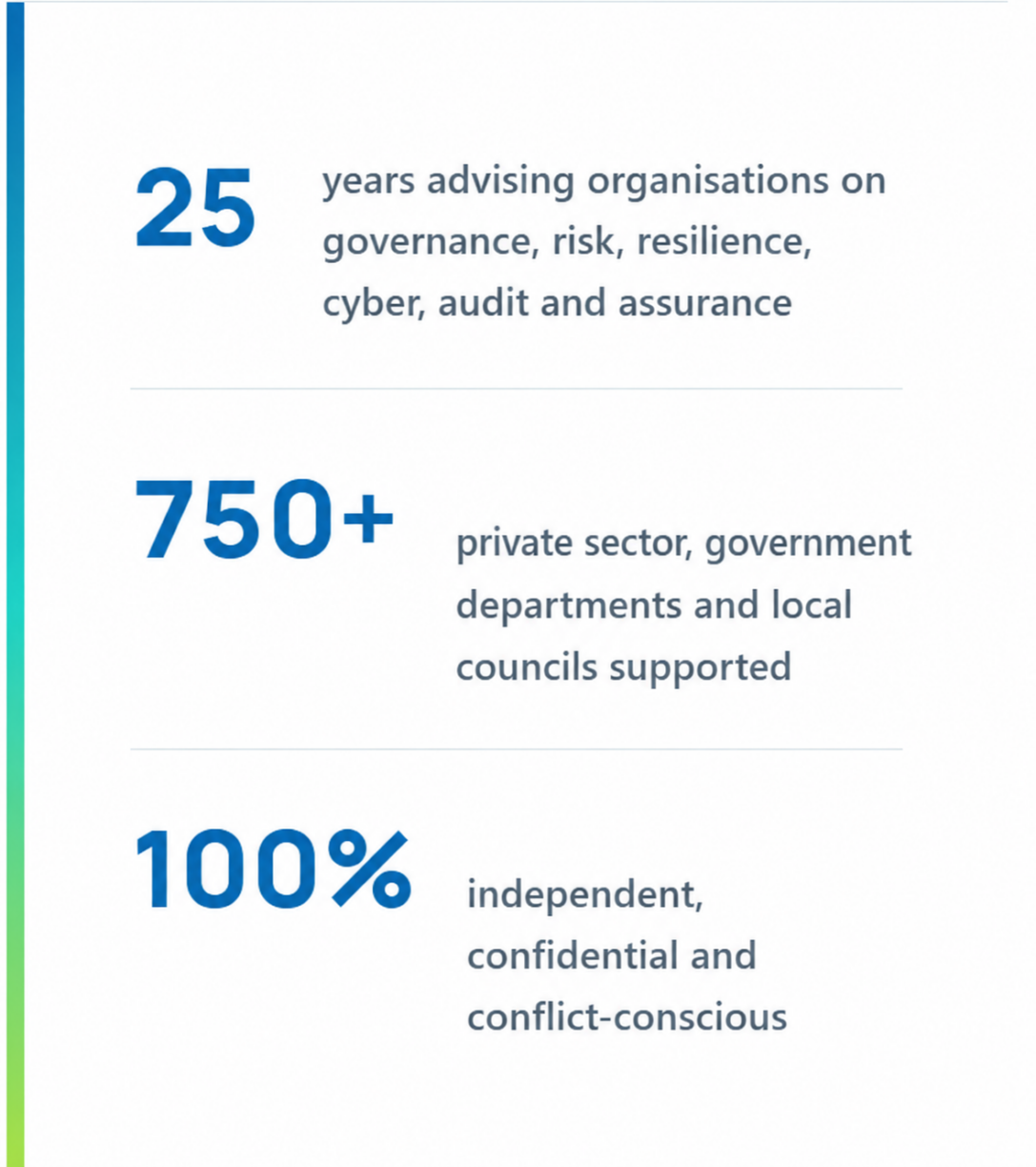
🎉 Celebrating 25 YEARS of helping organisations confidently take risk 🎉
- +61 2 9241 1344
Most Audit and Risk Committees (ARC) are well-intentioned, properly constituted and technically compliant. But compliance and audit and risk committee effectiveness are not the same thing.
A committee can meet every requirement on paper while quietly missing the emerging risks, control oversight and governance gaps it exists to catch.
The difference between an effective and high-performing ARC and one that is merely functional is rarely visible from within – it takes an independent, expert eye to see it clearly. That is what our Independent ARC Performance Review is designed to uncover.
The ARC performance review helps to strengthen oversight, surface blind spots, and improve operating effectiveness.

The most effective Audit and Risk Committees are doing more than meeting their obligations – they are actively shaping the quality of governance and risk oversight across their organisations.
The most common barriers to ARC effectiveness are surprisingly consistent across sectors – agendas dominated by retrospective compliance reporting that leave little room for genuine risk challenge; skills and composition that reflect yesterday’s risk environment rather than today’s; and committee dynamics that have grown too familiar to sustain the level of candour, rigour and accountability that effective oversight demands.
Retrospective reporting crowds out forward-looking risk oversight and strategic challenge.
Skills and experience may not reflect today’s cyber, digital and operational risks.
Familiar routines and relationships can dilute challenge, openness and accountability.
Trusted by listed entities, high growth brands, start-ups, APRA regulated entities, not-for-profits and government organisations across Australia.
1. Uncompromising independence
We hold no external audit mandates and carry no incentive to recommend unrelated services. Our only obligation is to provide an honest, objective and confidential assessment of your committee’s effectiveness.
2. Committee literacy
Our senior consultants sit on committees and/or advise ARCs and boards. We understand both governance frameworks and the human dynamics behind them.
3. Better practice alignment
Our assessment is calibrated to your regulatory environment. Findings are aligned to better practice in your sector.
We examine formal structures, observable behaviours and the committee’s practical impact on governance and risk decisions.
Is the charter fit for purpose? Are roles, delegations and responsibilities clear and aligned?
Does the committee have the independence, diversity and modern risk literacy it needs?
Are meetings focused and forward-looking? Is debate candid, informed and constructive?
Does the committee surface blind spots, influence decisions and drive action to completion?
We begin with a structured review of the ARC charter, terms of reference, meeting agendas and committee papers, minutes, internal audit reports, management letters and any prior effectiveness assessments. This establishes a clear fact base before consultations begin.
Individual interviews are conducted with each ARC member, representatives from the governing body and key members of the executive team who interact with the committee. Confidentiality is absolute. These conversations surface the real dynamics, gaps and effectiveness barriers that documents do not reveal.
A clear, evidence-based report sets out findings against each effectiveness pillar, peer benchmarks relevant to your sector and size, identified gaps, and a prioritised, practical improvement roadmap. Recommendations are designed to be acted on — not filed.
We adapt the evidence, benchmarks and recommendations to the standards your committee is accountable for.
Aligned with relevant state and local government risk management and internal audit guidelines, with attention to the ARC’s role in public accountability, value-for-money, assurance and compliance with legislative obligations.
Assessed against ASX Corporate Governance Principles and contemporary governance practice, with particular emphasis on cyber resilience, ESG oversight, continuous disclosure obligations and practical committee impact.
Mapped to APRA prudential standards, including the CPS 510 governance reforms with particular focus on the ARC’s oversight of internal audit independence, risk governance and culture and the regulated entities accountability framework.
Aligned to ACNC governance standards, with focus on the ARC’s oversight of financial stewardship, safeguarding, grant accountability and the resource constraints that shape how many NFP committees operate in practice.
Annual self-assessment builds discipline and encourages reflection. However, committees assessing their own effectiveness can overlook the same behaviours and assumptions the review is intended to surface.
A confidential discussion costs nothing and carries no obligation.
The committee has not been independently assessed in the past two to three years.
New members or a new chair create an opportunity to reset expectations and ways of working.
The organisation is preparing for a regulatory review, prudential audit or governance assessment.
Audit findings are not being resolved at the pace or to the standard the committee expects.
The committee now operates in a materially more complex risk environment than at its last review.
The governing body or chair wants confidence that committee performance matches the organisation’s risk profile.
An accessible starting point for committees wanting a quick view of strengths, gaps and immediate priorities.
A focused diagnostic combining structured digital input with targeted independent analysis and consultation.
A comprehensive independent review that assesses formal governance, stakeholder perspectives and real committee behaviours.
Not sure which option fits? InConsult can recommend the right level based on your objectives, regulatory context, timing and budget.
Chief Information Officer, Health Insurer.
Most committees review their own performance annually. An independent external review – typically every two to three years, or following a significant governance event provides the objectivity that a self-assessment cannot.
If your committee is preparing for a regulatory review, has recently changed in composition, is navigating a period of elevated risk, or simply wants an honest external perspective on what is working and what is not, we would welcome a confidential conversation.
Not ready for a full review? Learn more about ARC effectivness.